|
|
|
|
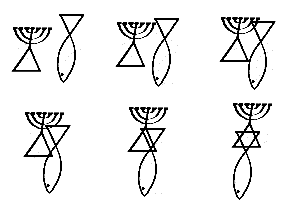
"Jew & Gentile One in Messiah"
As it was in the beginning so it will be in the end-of-days

The Torah writes:"And you shall count for yourselves from the morrow of the Shabbat, from the day that you bring the omer [offering] that is raised, seven complete weeks there shall be until the morrow of the seventh week you shall count fifty days (Leviticus 23:15-16).
Shavuot (Feast of Weeks/ Pentecost) is the Biblical harvest-festival celebrated 50 days after the Sunday which falls out during Passover. These fifty days are called the Counting of the Omer. The Rabbis incorrectly celebrate Shavuoth on the 6th of Sivan.
What is Shavuot?
Hag Ha-Shavuot, is the second of the three annual Hagim [Pilgrimage-Festivals] in the Hebrew Calendar and is known in English as the Feast of Weeks or Pentecost. Shavuot is also referred to in the Torah as Hag HaKatzir (Feast of Harvest) [Ex 23,16] and Yom HaBikurim (Day of Firstfruits) [Nu 28,26]. In Post-Biblical times Shavuot was believed to be the anniversary of the Revelation at Sinai, but there is no basis for this in the Tanach (Hebrew Bible).1
When is Shavuot?
Unlike all the other Holidays in the Tanach, the Feast of Weeks is not given a fixed calendar date but instead we are commanded to celebrate it at the end of a 50-day period known as "The Counting of the Omer" (Shavuot being the 50th day).2 The commencement of this 50-day period is marked by the bringing of the Omer Offering in the Temple as we read, "And you shall count from the morrow after the Sabbath from the day you bring the Omer [Sheaf] of Waving; seven complete Sabbaths shall you count... until the morrow of the seventh Sabbath you will count fifty days... and you shall proclaim on this very day, it shall be a holy convocation for you " (Lev 23,15-16.21). In late Second Temple times a debate arose between the Boethusians and the Pharisees about whether the "morrow after the Sabbath" [Heb. Mimohorat Ha-Shabbat] refers to the Sunday during Hag HaMatzot [Feast of Unleavened Bread] or the second day of Hag HaMatzot (i.e. the 16th of Nissan). Like the Boethusians and Ancient Israelites before them, the Karaites count the 50 days of the Omer from the Sunday during Hag HaMatzot and consequentially always celebrate Shavuot on a Sunday.
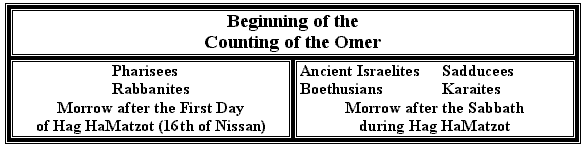
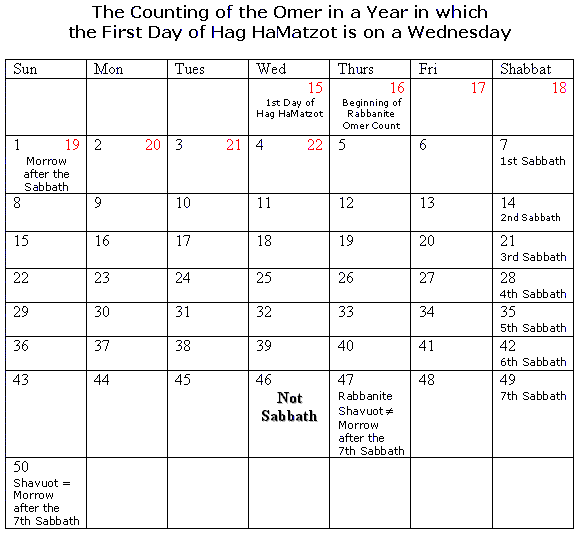
The Rabbanites claim that in the phrase "the morrow after the Sabbath" the "Sabbath" referred to is the first day of Hag HaMatzot. They argue that this day is referred to as a Sabbath because work is forbidden on it. However, the fact is that the Tanach never calls this day a Sabbath3 and if we look at the actual commandment in the Torah, this Rabbanite interpretation is untenable. We are commanded in Lev 23,16 "Until the morrow after the seventh Sabbath shall you count fifty days". While the first day of Hag HaMatzot could theoretically be called a Sabbath there is no way the 49th day of the Omer could be called a Sabbath, since (according to the Rabbanite theory) this day is neither a holiday nor a Sabbath. This being so, in the Rabbanite reckoning the 50th day of the Omer (=Shavuot) would NOT be on "the morrow after the seventh Sabbath" as commanded in Lev 23,16. Instead it would be on the morrow after the 7th Tuesday, Wednesday, or Thursday or whatever day it happened to fall out after (see chart). The only way for the 49th day of the Omer to be a Sabbath, thereby making the 50th day "the morrow after the Sabbath" as commanded in Lev 23,16, is if the 1st day of the Omer is on a Sunday.
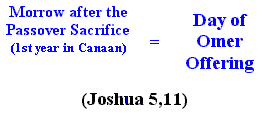
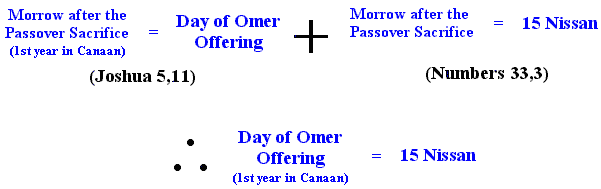
Another passage, which indicates that the first day of the Omer has to be the Sunday during Hag HaMatzot, is Joshua 5,11. This verse reports the events surrounding the cessation of the Manna shortly after the Children of Israel's entered into the Land of Canaan, "And they ate of the produce of the land on the morrow after the Pesach [sacrifice], Matzot and parched [barley] on this very day. And the Manna ceased on the morrow when they ate of the produce of the land...". As may be recalled, the Children of Israel were forbidden to eat of the new crops until the day of the Omer Offering as we read in Lev 23,14 "And bread and parched [barley] and Carmel you will not eat until this very day until you bring the sacrifice of your God; it shall be an eternal statute for your generations in all you habitations." Clearly Josh 5,11, which describes the eating of "Matzot and parched (barley)... on this very day" is a reference to the command in Lev 23,14 "And bread and parched (barley)... you will not eat until this very day." (see diagram).
Thus Joshua 5,11 is reporting that the first Omer Offering in the Land of Israel was brought on the "morrow after the Pesach [Sacrifice]" after which the Children of Israel were permitted to eat of the produce of the land, which they immediately proceeded to do.
When is the "Morrow after the Pessach"?
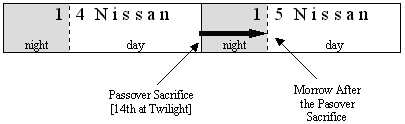
Was the "Morrow after the Pessach" in Joshua 5,11? It is important to remember that in the Tanach the term Pessach [Passover] always refers to the Passover Sacrifice while the holiday on which the sacrifice is brought is called Hag HaMatzot (Feast of Unleavened Bread). So Joshua 5,11 is talking about the morrow after the Passover Sacrifice. But when was this "morrow"? On the morning of the 15th (i.e. the following morning) or the morning of the 16th. The term Mimoharat, literally on the morrow, means on the following morning. The expression "Morrow after the Sabbath" refers to Sunday morning, because the Sabbath is a 24-hour event ending on Saturday night and Sunday morning is the morning which follows (see diagram). Similarly, the "Morrow after the Pesach [sacrifice]" must be the morning immediately following the Pesach sacrifice. Remembering that the Pessach Sacrifice was brought on the end of the 14th of Nissan at twilight (cf. Ex 12,18; Dt 16,4), the following morning is the morning of the 15th (see diagram).
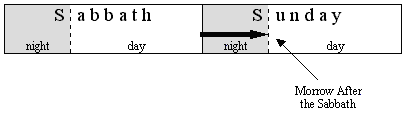
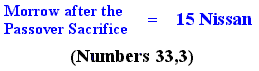
This deduction is confirmed by Nu 33,3, which relates "And they traveled from Ramses in the first month on the 15th of the month; on the morrow after the Pesach [sacrifice] the Children of Israel went out with a high hand in the eyes of all Egypt." The above passage describes the day of the Exodus both as the 15th of the first month and as the Morrow after the Pesach Sacrifice. This verse conclusively shows that the "Morrow after the Pesach [sacrifice]" is equivalent to the morning of the 15th of Nissan!
Returning to Joshua 5,11, we have seen that in the year Israel entered Canaan the Omer Offering was brought on the "Morrow after the Pesach [Sacrifice]" which we now have established is the morning of the 15th of Nissan. Apparently in that year the 14th of Nissan fell out on a Sabbath and the 15th of Nissan fell out on a Sunday (since the Wave Sheaf offering is always brought on a Sunday). The Rabbanite theory that the Omer Offering is brought on the 16th of Nissan is clearly refuted by the above passage, for in the year that the Children of Israel entered Canaan the Children of Israel brought the Omer Offering on the 15th of Nissan and not the 16th!
The above also answers another seemingly difficult question, namely, does the Omer count begin with the Sunday during Hag HaMatzot or the Sunday after the Sabbath during Hag HaMatzot. Essentially, the question is what part of the phrase "the morrow after the Sabbath" must fall out during Hag HaMatzot, "the morrow" or "the Sabbath"? The only ramification of this semantic quandary is when the 15th of Nissan falls out on a Sunday. In this instance, is the Omer Offering brought on the 15th of Nissan (morrow is during Hag HaMatzot) or the 22nd (Sabbath is during Hag HaMatzot)? The evidence from Josh 5,11 and Nu 33,3 provide a precedent which clarifies this situation since in the year the Children of Israel entered Canaan the 15th of Nissan actually fell out on a Sunday and the Omer Offering was brought on the 15th of Nissan, not the 22nd!
Notes:
Note 1: The Revelation at Sinai did occur towards the beginning of the Third Month (Sivan) and Shavuot always falls out towards the beginning of the third month. Like Shavuot, the exact date of the Revelation of Sinai is not specified,and it is tempting to connect the two. However, it is important to remember that the connection between the two events is never made in the Tanach and as it is written, "You shall not add to the word which I command you, neither shall you diminish from it, in order that you will keep the commandments of YHWH your God which I command you." (Dt 4,2). Back
Note 2: The name "Counting of the Omer" for the period between the Omer Offering and Feast of Weeks does not appear in the Tanach and is used here by common convention. Back
Note 3: It is worth noting that Yom Kippur is the only other day besides the weekly Sabbath, which is also referred to as a Sabbath. The weekly Sabbath is referred to as YHWH's Sabbath ["Today is a Sabbath of YHWH" (Ex 16,25); "Keep My Sabbaths" (Lev 19,3)] while Yom Kippur is referred to as Israel's Sabbath ["It shall be a Sabbath of restfulness for you" (Lev 16,31; 23,32)]. The Sabbatical Year (Shemitah) is also called the Sabbath of YHWH (Lev 24,4-5). It is also worth noting the term Shabbaton, which is used to describe some of the Holy Days. It should be emphasized that the term Shabbaton is not the exact equivalent of Sabbath [Shabbat] nor is it ever used interchangeably with it. Indeed, the term Shabbaton is derived from the same root as Sabbath although its exact connotation is unclear. Shabbaton seems to be the adjective form of the word Sabbath and means something like "Restfulness" or "rest-period". Thus the weekly Sabbath is described as a Shabbat Shabbaton, meaning a "Sabbath of Restfulness". Similarly, the 7th year is called a Shenat Shabbaton, meaning a "Year of Restfulness" (usually translated "Sabbatical Year"). The term Shabbaton is also applied to Yom Teruah (Lev 23,24), the first day of Sukkot (Lev 23,39), and Shemini Atseret (8th Day of Sukkot) (Lev 23,39). The terms Sabbath and Shabbaton are never used to describe any of the days of Hag HaMatzot nor are ANY of the Holy Days ever called a Sabbath other than the weekly Sabbath itself. The only exception is Yom Kippur which is the holiest day of the year on which even eating is forbidden. In contrast, on the Holy Days of Hag HaMatzot (1st and 7th days) it is permissible to cook and have fire (Exodus 12,16). Back
http://www.karaite-korner.org/shavuot.shtml
The Commandment of Counting
BA-RUCH A-TAH ADO-NAI E-LO-HE-NU ME-LECH HA-OLAM ASHER KID-E-SHA-NU BE-MITZ-VO-TAV VETZI-VA-NU AL SEFI-RAT HA-OMER.
Blessed are You, Lord our God, King of the Universe, who has sanctified us with His commandments, and commanded us concerning the counting of the Omer.
About the Counting of the Omer
The Torah writes:"And you shall count for yourselves from the morrow of the Shabbat, from the day that you bring the omer [offering] that is raised, seven complete weeks there shall be until the morrow of the seventh week you shall count fifty days (Leviticus
23:15-16).
These verses command us to count seven weeks from the time that the omer, the new barley offering, was brought in the Temple, i.e., from the sixteenth of Nissan. We begin our count on the second night of Passover (the night of the second Seder in the Diaspora) and continue until Shavuot, which is the fiftieth day after the offering.
We actually count forty-nine days, for our Sages had a tradition that the Torah's use of the word fifty meant until the fiftieth day.
It is a mitzvah for each individual to count the days of the omer by himself, for the Torah states: And you shall count for yourselves. This mitzvah is applicable today even though the Holy Temple no longer stands and we no longer bring the omer offering. Some maintain that the obligation today is Rabbinic.
The correct time for counting the omer is at the beginning of the night, for the verse states that we are to count seven complete weeks and the count can be complete only if we commence when the sixteenth of Nissan begins.
Since we commence counting the omer at night, we continue to count at night throughout the entire forty-nine days.
It is customary that following the counting of the omer, one recites Psalm 67, for according to tradition that psalm has forty nine words, corresponding to the days of the omer
In the Diaspora, where a second Seder is conducted on the night of the sixteenth of Nissan, some have the custom to count the omer at the end of the Seder. Were we to count before the Seder, we would declare the day as the sixteenth of Nissan, and the second Seder, which is held because of a doubt that the date might really be the fifteenth, would seem to be superfluous.
It is customary among the pious and righteous to read the Torah portion which deals with the omer, at the conclusion of the Seder, in Eretz Yisrael, and at the conclusion of the second Seder in the Diaspora.
The word for "number" in Hebrew is mispar. Its root is closely related to the word for "story" -- sipur. What is the relationship between the two?
A collection of events becomes a story -- as opposed to a random anthology of events -- when there is a beginning in which the characters are introduced, a middle in which conflict takes place, and an end in which there is resolution.
Our lives flow by so quickly that we frequently lose awareness of the awesome power of our own stories. The metamorphosis of today into tomorrow is subtle enough for us to lose consciousness of beginnings and ends.
The commandment to count teaches us mindfulness, and it re-opens our hearts to hearing stories.
The commandment to count teaches us mindfulness. It re-opens our hearts to hearing stories. And what story is being told?
There are two stories that are intertwined.
One is the story of a transformation of a people who at Passover become physically free into a people who at Shavuot become spiritually free as well.
The day we left Egypt was one in which we rejected the Egyptian definition of what our lives can hold. We were free to be who we wanted to be. But we didn't yet know our own story. It is only when we received the Torah that we found the channels that could give our souls expression.
It was then that we learned the mechanics of meeting challenges that are genuine and enduring. Our story began to evolve.
BARLEY AND WHEAT
The rituals that define this time of year reflect this change. The sacrifice that was offered on Passover was made out of barley. In ancient times, barley was used as fodder for animals. The sacrifice that was offered on Shavuot was made of wheat. Wheat is often used as an allegory for the human capacity for using our intelligence. While an animal can eat a fruit or a leaf, it requires human intelligence and creativity to make bread.
The Jewish people were transformed from those seeking freedom to those seeking humanity.
What makes us truly human? The mystic literature discusses the bonds that we share with God as being the humanizing factor. These bonds are called sefirot, a name which, as is obvious, also has the same root as number and story.
This common root conveys the fact that our beginning, middle and end are ultimately measured and finite, but nonetheless touched by the infinite spark of Godliness within us.
One of the most central of his teachings is the significance of gaining awareness of the bond that we share with God, the sefirot of our spiritual souls.
Jer 31:31 Behold, the days come, says the LORD, that I will make a new covenant with the house of Yisra'el, and with the house of Yehudah:
Jer 31:32 not according to the covenant that I made with their fathers in the day that I took them by the hand to bring them out of the land of Egypt; which my covenant they broke, although I was a husband to them, says the LORD.
Jer 31:33 But this is the covenant that I will make with the house of Yisra'el after those days, says the LORD: I will put my law in their inward parts, and in their heart will I write it; and I will be their God, and they shall be my people:
Jer 31:34 and they shall teach no more every man his neighbor, and every man his brother, saying, Know the LORD; for they shall all know me, from the least of them to the greatest of them, says the LORD: for I will forgive their iniquity, and their sin will I remember no more.
THE SEVEN ASPECTS OF GODLINESS
This next section is from Orthodox Judaism but it matches up well with the fruit of the Spirit that we see in Galatians.
Gal 5:22 But the fruit of the Spirit is love, joy, shalom, patience, kindness, goodness, faith,
Gal 5:23 gentleness, and self-control. Against such things there is no law.
Let us now examine the bonds with God that make us human --- the seven expressive aspects of Godliness.
1. The first is chessed, "kindness."
While the drives of the body are towards oneself, those of the soul are directed outwards towards others. We love those to whom we give because they validate our spirituality. We see our highest self-reflected in them.
2. The second is gevurah, "strength" or "empowerment."
Specifically this refers to empowering one's soul to overcome the obstacles that stand before it. We have the capacity to live for the sake of our goals, and to make sacrifices to attain it. The ultimate goal of every Jew is to be a source of light. In order to do this, we must submit our egos and desires to the scrutiny of God's Torah.
3. The third is tiferet, "beauty."
Beauty is created through harmony and contrast -- that is when we make a "match." When we become people of truth, our words, thoughts, and deeds match. Only humans can lie. The reason for this is that only humans have the possibility of creating themselves in a certain sense. To use the words of the Maharal of Prague, "we give birth to ourselves." When we lie we succumb to our animalistic desire for comfort and ease. When we tell the truth, we reconnect to Gods transcendental reality and chose to be authentic as humans
4. The fourth is netzach, "infinity."
Anyone who has ever resisted the desire for immediate gratification has touched this quality. It is the source of hope and aspiration towards growth.
5. The fifth is hod, "gratitude."
In Hebrew hod is a noun which literally means "splendor," but as a verb means both "to confess" and "to thank." As humans we can be moved by splendor whether its source is spiritual or physical. Our ability to be truly sensitive in this sense is what inspires us to express gratitude. We often resist allowing ourselves to be grateful because of the fragility of our self-esteem. When we begin the day with the words Modeh Ani, "I thank you," we express gratitude towards God, and simultaneously see our selves as creations that are worthy of life.
6. The sixth is yesod, "foundation."
This refers to our ability to bond. It is called "foundation" because it is the very foundation of all interactions. What we ultimately seek in relationships is goodness. Inevitably if we had to choose one trait in a perspective spouse, it would be a spiritual one. For some of us it would be compassion, for others honesty or sensitivity. If we see our own goodness mirrored back to us, we love the person even more. What this tells us is that what we are seeking is in the final analysis, spiritual bonding. We are searching for the face of God.
7. The final attribute is malchut, "kingdship."
It refers to our ability to bring God's kingdom into being in the greater world and into our own hearts. The way we do this is through the recognition that our missions are of infinite significance; at the same time we retain the humility that comes as a result of knowing what a tiny piece of infinity we can individually call our own.
The seven weeks between Passover and Shavuot have the spiritually potency to give us the ability to let our stories unfold. We can make every day count, and emerge more human than we ever could have imagined.
Hopes & Dreams HB004 Shavuot 5768/2008
|
Yeshayahu/Isa |
Romans |
Vayikra/Lev |
Acts |
pentecost |
Isa 55:7 Let the wicked person abandon his way and the evil person his thoughts; let him return to Adonai, and he will have mercy on him; let him return to our God, for he will freely forgive.
Isa 55:8 "For my thoughts are not your thoughts, and your ways are not my ways," says Adonai.
Isa 55:9 "As high as the sky is above the earth are my ways higher than your ways, and my thoughts than your thoughts.
Abandoning things that do not work in the eyes of Adonai. Putting your hopes and dreams on Him. It is tough living in this world having that trust. But when we do have that trust in Him and in His perfect ways our marriage to Him is sweet. Many people have this misguided idea that Pentecost was this new thing the Lord was doing. No it was not. Shavuot/Pentecost is about the Almighty remembering His commitment to us His people. Shavuot is the day on HIS calendar that He picked for us to remember the day He gave us His word. When the people were in the desert receiving the word from the Lord it was not just the Jews but also the nations…Goyim!!! All people agree and accepted His wedding contract to us the world. Take the time to take a serious ride through His word to find out what you have agreed to. At the end of the message you will here people taking turns interceding for there countries.
En inglés y español
click here for dial-up
Hebrew "Jewish" Moedeem "Holy days" Listing for 2007
|
Jewish
Holiday |
|
|
| Feast of matzah |
| First Fruits |
|
Beth Goyim Messianic Congregation is like the
first congregation/church at Antioch. Jew and Gentile one in Messiah. So
it was in the beginning so shall it be in the end. Knowing Yeshua
(Jesus) the Messiah is not about religion it is about faith.
|
|
home |
We’ll be looking to see you this week at our

new home
20-26 Industrial Ave. 2nd floor (there is an elevator)
Fairview, NJ 07022
FREE parking
|
|
|

|
|
|
|
Statement of our Faith |
This week's message |
The Remnant's Call TV show |
Links |
Holydays |
 |
|
|
|
|
 |
| Daily Devotional | About us/Bio | Charts | Upcoming Events | Videotracts | Service times & Directions |
|
Beth
Goyim Messianic Congregation is like the first congregation/church at
Antioch. Jew and Gentile one in Messiah. So it was in the beginning so
shall it be in the end. Knowing Yeshua (Jesus) the Messiah is not about
religion it is about faith.
|
|
Home |